|
||||||||||||||||
|
Looming some 384.400 km (239,000 miles) from the Earth, with a diameter of 3476 km (2,160 miles) and a mass of 7.35e22 kg. shines the Moon. The Moon is the brightest object in the night sky and only second in brightness to that of the Sun. Its mean density is only 3.34 times that of water. It has no real atmosphere and no magnetic field of its own and is the only natural satellite of our planet Earth. In fact, the Moon is next to the largest moon in our solar system; the Earth and Moon can almost be said to be a double planet. The Moon undergoes extremes in temperature: it is alternately scorched to +110 degrees celsius during the day and frozen to -180 degrees celesius at night. Many of us have seen its eclipses and occultations. The Moon shines by reflected sunlight as it passes through each of its familiar phases, and the Moon (with a little help from the Sun) also controls the ocean's tides.  Moon Statistics Moon Statistics
|
The Moon's Origins
The Moon's origins still remain unsettled. A similarity in the composition of the Moon with the Earths rules out any sort of capture theory. One of the most probable theories is that at one time, a giant object, conceivably the size of Mars, collided with the primordial Earth, shattering what crust the earth had. The sheer force of an impact this size is believed to have forged an immense gorge, melting the Earth's crust, and ejected a shower of molten rock and part of the Earth's mantle into orbit. It is believed that the material then condensed to form a massive ring of orbiting debris. The Moon then formed from this substance.

The Moon's Composition
The Moon possesses a thick outer
crust (60 km) and below the crust
a mantle (60-1000 km), and a partly liquid core (1000-1740 km). Much of
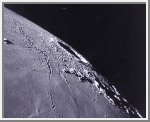
the surface is fractured by massive impact craters formed
by meteorites, flooded by molten lava, and carved out from volcanic
explosions. The Moon's surface shows the scars of more than 3
billion years of meteorite impacts, most of which developed between
3000 and 4000 million years ago. The youngest Moon rocks are virtually
as old as the oldest Earth rocks. The largest craters are approximately
200 km in diameter, while the smallest are only about a meter
across. Impact features include crater clusters, dark halo craters,
rays, and crater chains. Recent data acquired by the Clementine
spacecraft indicates that there is also ice in the bottom of a crater
located on the Moon's South pole.
 The Moon's surface is covered by a rocky material called the lunar
Regolith. The Regolith consists of fine dust particles, glass spheres and a jumble of large boulders and rocky debris, produced
by constant meteor bombardments occurring throughout geological
time. Dust particles were created by the Moon's surface melting
by the heat of the impacts.
The Moon's surface is covered by a rocky material called the lunar
Regolith. The Regolith consists of fine dust particles, glass spheres and a jumble of large boulders and rocky debris, produced
by constant meteor bombardments occurring throughout geological
time. Dust particles were created by the Moon's surface melting
by the heat of the impacts.
Some of the rarer moon rocks include granite, pyroxenite, norite, green glass, tractolite and denite.
When Apollo 11 astronauts returned from the first moon landing, scientists were able to analyze samples of rocks they had collected, known as basalts. These rocks were found to contain three previously unknown minerals: pyroxferroite, armalcolite and the substance—dubbed tranquillityite after the Sea of Tranquility. Large portions of the lunar crust also appear to be composed of rocks with high concentrations of the mineral anorthite.
Read more about moon rocks and minerals here
The minerals of the Moon are also comprised of more than 40% oxygen by mass. To quote Dr. Philip Metzger:
"The whole Moon is one giant ore body of oxygen, one great big cheese. The cheese of lunar resources is oxygen."
You can read his article here: Moonrakers: Getting the Big Cheese! by Philip Metzger
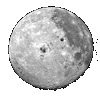
The Moon's terrain is divided into two sharply contrasting areas, the light rugged and very ancient mountainous regions (terrae) and the dark smooth and younger lowlands (Maria). The Maria comprises about 16% of the Moon's surface and consists of huge impact basins flooded by molten lava some 3000 million years ago. The Maria, for some unknown reason, are concentrated on the near side of the Moon. The Mare Imbrium is the largest crater with a diameter of 420 miles (676km). It is rimmed by a mountain range, and was created by the imapct of an asteroid with an estimated diameter of 80 miles.
The Lunar Highlands are topographically higher then the Maria and are characterized by elevated rims of craters, volcanic domes and plateaus, although few have slopes that exceed a 12% incline. These are surrounded by the rolling hills of basin ejecta blankets, consisting of crushed rock blasted out of the crater by meteorites. The dark lunar plains show wrinkled ridges a few hundred feet high and an unusual type of valley known as a "rille". The rille has a flat floor and steep parallel walls.
| Moon Pages (Navigation Bar) | ||
|---|---|---|
 The Moon The Moon in Religion |
 Moon Legends Moon Legends and Tales |
 The Moon The Moon in the Arts |


 |
All Rights Reserved Click here for Copyright information |
A member of 
|

| ||